
Policy statement by the Federal Chancellor ahead of the European Council
In his policy statement to mark the upcoming European Council, Federal Chancellor Merz calls for more defence capability, less regulation and greater competitiveness for Europe. Germany wants to be the driving force and stability factor within this.
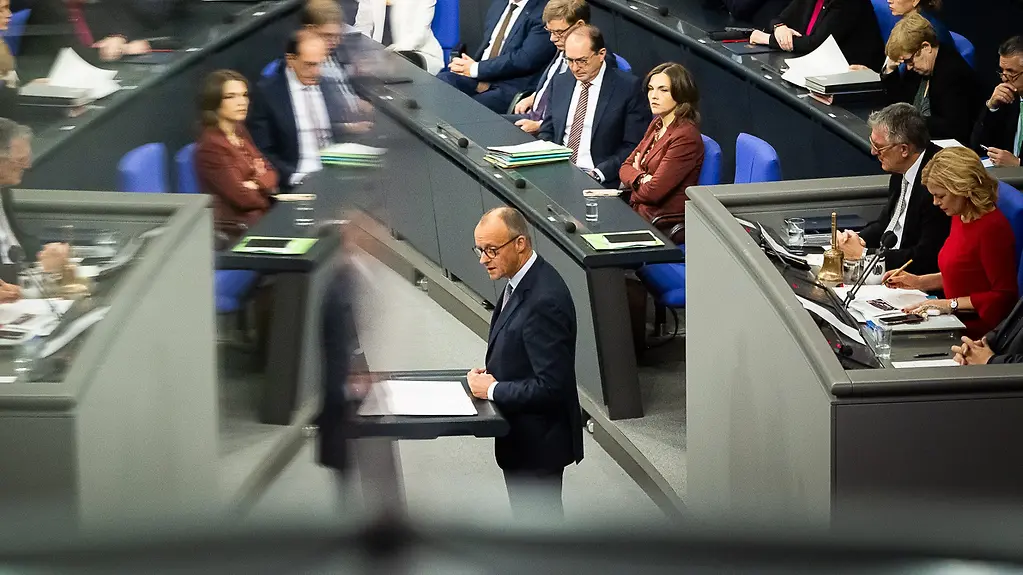
In his policy statement, the Federal Chancellor called for Europe to become a force for peace.
Photo: Federal Government/Steffen Kugler
Before Federal Chancellor Friedrich Merz looked ahead to the upcoming European Council in his policy statement, he looked back on the developments of the last few days: “After 738 days in captivity, all 20 surviving hostages were released from the hands of the terrorist organisation Hamas on 13 October.” He went on to say that this moment of joy and relief, but also the silencing of weapons, was made possible by the decisive action of the international community.
Merz took up the idea of firm international cooperation and looked at the role of the European Union in the world. “Europe must utilise its opportunities with greater unity and determination”, said the Federal Chancellor immediately before the meeting of European heads of state and government. Europe, he said, had the power to make the world a better place. “Being a force for peace is and remains the basic idea of the European Union”, said Federal Chancellor Merz in the Bundestag.
The Federal Chancellor spoke about issues including …
... Defence against hybrid attacks
Federal Chancellor Merz emphasised that a strong and united Europe posed no threat whatsoever. This came solely from Putin. Hybrid attacks from Russia are also taking place in Germany. Merz responded to this very clearly: “We will not be frightened. We will not allow our free society to be unsettled by hybrid attacks.” The newly established National Security Council would, he said, discuss a comprehensive action plan in the next few days to effectively combat these hybrid attacks from Russia. He referred to this as a national task for society as a whole.
... Support for Ukraine
Merz emphasised that the European community is united in standing resolutely behind Ukraine. He said that the pressure on Russia to stop the aggression and agree to peace negotiations would be further increased. The 19th EU sanctions package against Russia was already being negotiated with this in mind. The financial protection of Ukraine by utilising frozen Russian government bonds was also to be pursued further, according to Merz. “We don’t want to do this to prolong the war. We want to do this in order to end this war as quickly as possible”, said Federal Chancellor Merz.
... Defence in Europe
Federal Chancellor Merz stated that the EU was also resolute about the need to quickly and effectively increase its own defence capabilities. “We want to be able to defend ourselves so that we don’t have to defend ourselves”, said Federal Chancellor Merz, summarising the Federal Government’s position. The aim, he said, was still to develop the Federal Armed Forces into the strongest conventional army in Europe. A European force for peace was defined by its strength, its deterrent capabilities and its commitment to the free and democratic basic order, Chancellor Merz said in summary.
... Migration in Europe
For the Federal Government, Merz said, effective protection of the external borders was a prerequisite for the European idea to function in the future. Federal Chancellor Merz called for effective cooperation between the EU Member States, but also for the consistent implementation of migration rules. He said that, over the course of the year, the number of asylum seekers in Germany had fallen by almost 60 percent. Merz stated that he believed that the Federal Government was on the right track when it comes to repatriations, but that migration was not a national challenge, but a European one. The Common European Asylum System needed to be transposed into national law in all Member States.
... Competitiveness in Europe
Federal Chancellor Merz sees the European community as being at a historic crossroads. He said that the necessary strength of the EU was based to a large extent on its competitiveness. According to the Federal Chancellor, impetus is needed here. He said that there was “no knowledge problem”, but rather “an implementation problem”. “Europe will only become more productive if it changes fundamentally”, said Federal Chancellor Merz.
... Regulation in Europe
For Federal Chancellor Friedrich Merz, one of these important changes is the effective dismantling and reduction of regulations in the EU. He summarised his demands in the following formula: “An end to regulatory frenzy, faster procedures, more open markets, more innovation and more competition.” At the same time, the Chancellor countered the accusations that this approach contradicts the common climate goals. It is not regulation and bans, but open technology, innovation and competitiveness that are “an organic part of our economic and environmental policy”.
... Trade policy in Europe
Federal Chancellor Merz stated in his speech: “The exchange of goods and services has once again become an instrument of power in the world, to the detriment of those involved.” Europe, he said, was one of the most successful trading areas in the world and had also enabled Germany to achieve great prosperity. Merz appealed for Europe to utilise its potential “more decisively and with greater unity”. He said that trade agreements with new partners were an important step here. The Chancellor demanded that the treaty with MERCOSUR – the Common Market of South American States – be signed this year.
... Germany in Europe
Merz said that Europe, the EU, its Member States and the idea behind it now had the opportunity to decisively shape their own future. The Federal Chancellor promised that Germany would play an active and responsible role in this endeavour. He was in no doubt that the challenges ahead could be overcome. Strengths would need to be expanded and weaknesses systematically reduced. “The Federal Government is working for this strong Europe day after day”, said Chancellor Merz at the end of his policy statement.