
Olaf Scholz (SPD) was elected ninth Federal Chancellor of the Federal Republic of Germany in December 2021. He led the first “traffic light coalition”, consisting of SPD, Bündnis 90/Die Grünen and FDP, at the federal level.
The coalition agreement entitled “Venturing more progress” focussed on modernising the economy and society, social justice, and climate protection.
“Epochal change” owing to Russian war of aggression
Shortly after the term of office began, Russia’s invasion of Ukraine caused a profound turning point in the entire security order of Europe. Federal Chancellor Scholz spoke of an “epochal change” [Zeitenwende] in his government statement in the Bundestag on 27 February 2022. Reacting to the changed parameters of the peace and security situation, the Federal Government released special funding totalling 100 billion euros in order to strengthen the Federal Armed Forces. Germany became the largest supporter of Ukraine apart from the USA – politically, in humanitarian and financial terms, and through arms deliveries.
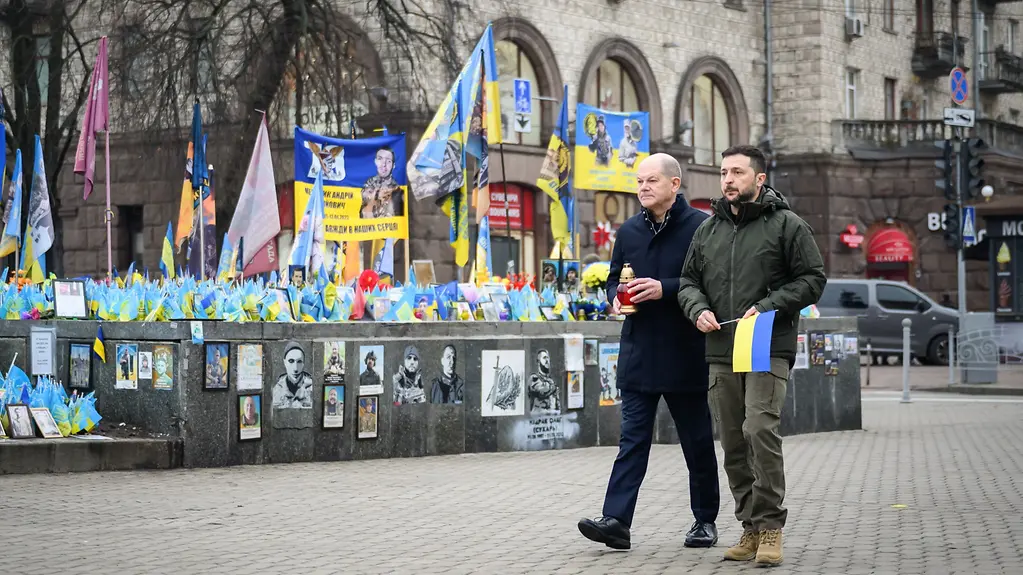
Federal Chancellor Olaf Scholz visited President Zelensky in Kyiv multiple times.
Photo: Federal Government/Marvin Ibo Güngör
In the next few years, the government’s actions were strongly influenced by coping with the effects of the Russian war of aggression. Within a very short time after the loss of Russian energy supplies, the Federal Government opened up new energy sources, erected LNG terminals at the northern German coasts and freed the country from dependence on fossil fuels from Russia. In parallel, the Federal Government cushioned the sharply increased energy and food prices with three large relief packages amounting to 300 billion euros. The expansion of renewable energy gained a lot of momentum, and the speed of development was doubled. This decisive action enabled the government to prevent the electricity and heating outages which some experts had feared would take place.
Germany pact and climate protection
In order to accelerate the climate-friendly restructuring of the country, improve infrastructure and reduce bureaucracy, the Federal Government implemented a number of measures for faster planning and authorisation procedures. Federal Chancellor Olaf Scholz worked with the federal states to draw up the “Germany Pact”, intended to achieve acceleration at all levels of the state. This significantly simplified and accelerated a number of processes in many areas, e.g. the development of renewable energy and the refurbishment of bridges.
Climate protection was a central concern of the Scholz government and was a component of many reform projects. A new Climate Protection Act brought the 2030 climate protection goals within reach. The Germany Ticket, which enables local and regional public transport to be used nationwide at a standard price, was a success.
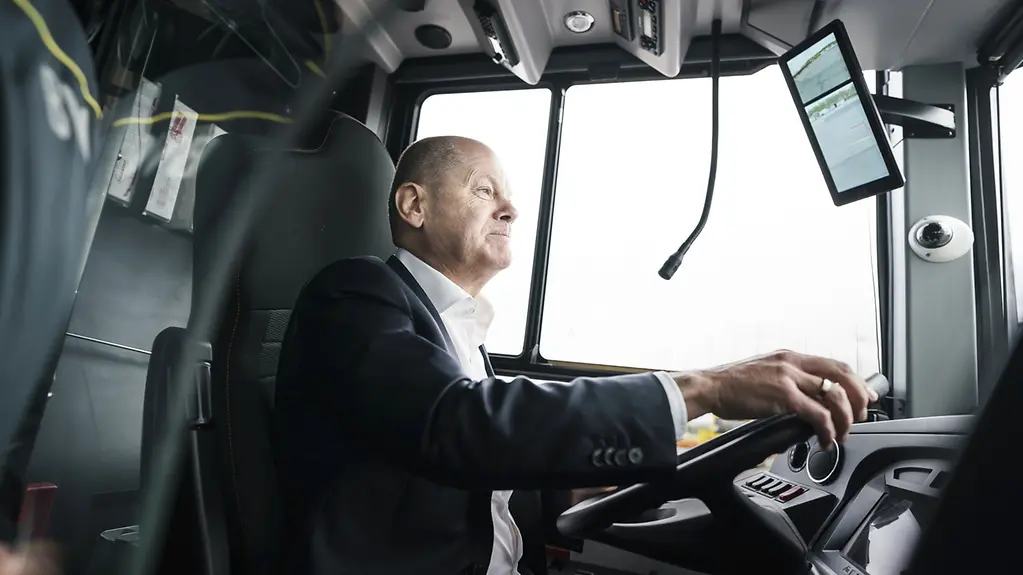
Federal Chancellor Scholz visited the public transport provider Berliner Verkehrsbetriebe (BVG) for the launch of the Germany Ticket.
Photo: Federal Government/Jesco Denzel
Strengthening the welfare state and regulating migration
Increasing the minimum wage to twelve euros per hour was a crucial measure at the beginning of the government and benefited over six million employees. Child benefit, student grants and pensions were also increased. More than 30 years after reunification, pensions were at the same level in Eastern and Western Germany for the first time.
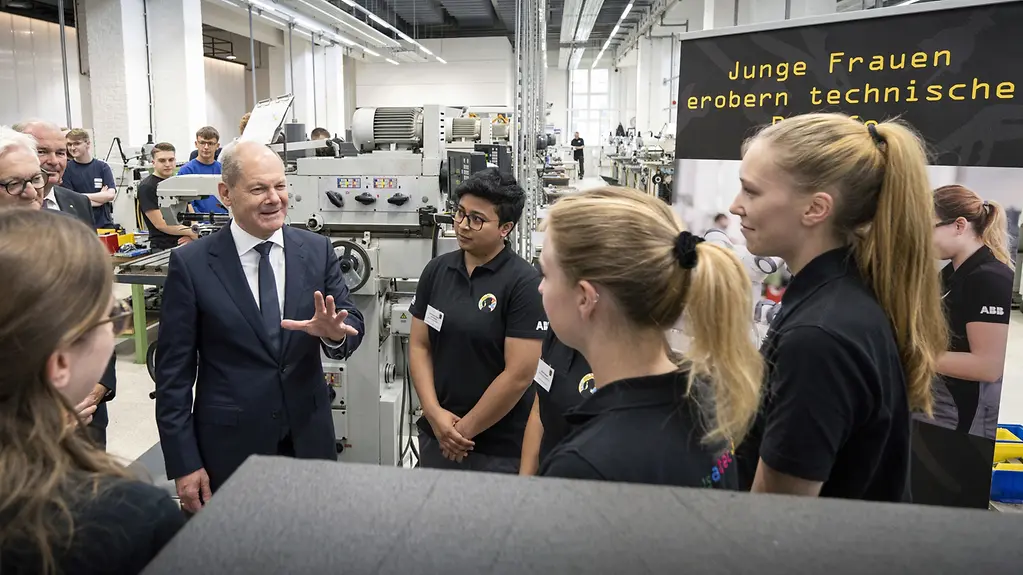
In many of his visits to companies – for example, here at xy – Federal Chancellor Scholz was particularly interested in the concerns of young people.
Photo: Federal Government/Guido Bergmann
On the topic of migration, the Federal Government followed a policy of humanity and order. A new Skilled Labour Immigration Act created better conditions in order to meet the need for workers, including those from abroad. Integration was strengthened at the same time. Irregular migration was significantly reduced, and laws enabling better control of regular immigration were passed. The Federal Government also campaigned successfully for a reform of the joint European asylum system.
Breakdown of the “traffic light coalition” and new elections
The traffic light coalition ended prematurely in November 2024. Following failure to reach an agreement about the 2025 budget, Federal Chancellor Olaf Scholz dismissed his Finance Minister, Christian Lindner (FDP). In order to enable early Bundestag elections, Federal Chancellor Olaf Scholz called a vote of confidence in the German Bundestag on 16 December 2024. The Bundestag elections then took place on 23 February 2025. The Federal Government remained as a minority caretaker government with the ministers from SPD and Bündnis 90/Die Grünen. On 6 May 2025, Friedrich Merz was elected the new Federal Chancellor.