
Chancellor Angela Merkel met in Beijing with Chinese Premier Wen Jiabao. A number of major contracts were signed in their presence.
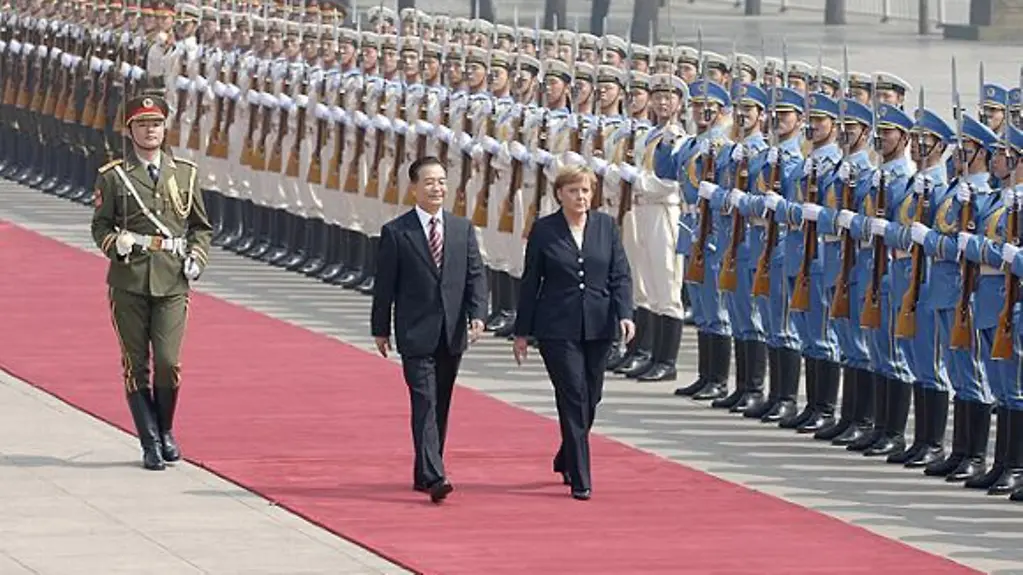
Honor guard reception for the German Chancellor.
Photo: REGIERUNGonline/Bergmann
"German-Chinese relations have great potential," Merkel observed, adding: "We want to expand these relations."
Friendly reception
Premier Wen Jiabao met with Merkel in an informal setting. They discussed a range of issues over a working breakfast and on a walk through Changpuhe Park.
Merkel noted that relations between the two countries are based on mutual trust, fairness, and openness, adding that they are on a firm foundation.
Cooperation in resolving international problems is becoming increasingly important. Speaking at a joint press conference, Merkel underscored the position the two sides take on Iran, saying: "We agree that Iran must not come into the possession of nuclear weapons."
Human rights indivisible
"We had an open discussion of human rights," Merkel indicated, noting that she stated clearly that human rights are indivisible. "It is important that differences in the amount of importance attributed to certain values be discussed openly," she said, adding that human rights will continue to be an important part of German-Chinese cooperation.
Deepening dialogue on rule of law
Justice Minister Brigitte Zypries is currently continuing the German-Chinese dialogue on the rule of law, a forum that supports democratic processes in China. "It is an important instrument of cooperation in the areas of justice and law," Merkel noted.
Major contracts concluded
Nineteen contracts were signed in the presence of the two heads of government. Siemens won a contract for the construction of between 300 and 600 locomotives and concluded an agreement on technical infrastructures for railway lines. SAP concluded a cooperation agreement on software for use by small and medium-size enterprises.
Lufthansa and Air China concluded a cooperation agreement. Air China signed an agreement to join the Star Alliance.
Agreements were also concluded between the German and Chinese governments, including on financial cooperation and cooperation in the area of road toll collection technology.
Protection of intellectual property
One of these agreements is intended to strengthen protection against product piracy. Premier Wen Jiabao gave his assurances that China sees protection of intellectual property as being in its own interest, noting that constant efforts are being made in this area but that numerous problems remain and that: "We will continue to increase the intensity of our efforts."
"Transrapid" talks continue
Negotiations are currently being conducted on extending China's "Transrapid" magnetic-levitation train line by around 160 kilometers to Hangzhou with a view to improving public transportation to the Expo 2010 site in Shanghai. "We're making good progress," Siemens Supervisory Board Chairman Heinrich von Pierer said in Beijing, noting that there are still a number of commercial and technical problems to be resolved.
"When I come back in a few years I would like to be able to take the Transrapid from Shanghai to Hangzhou," the Chancellor remarked.
Merkel's delegation included Economics Minister Michael Glos and Transport Minister Wolfgang Tiefensee, the latter responsible for negotiations on matters involving aviation, railways, and urban development.
In 2005 China's economy grew by 9.9 percent. Gross domestic product amounted to 2,230 billion dollars, making China the world's fourth-largest economy. It is currently the world's third-largest trading nation.
In recent years Germany has become the largest European investor in China and accounts for 4.7 percent of its foreign trade. In 2005 Germany exported goods to China valued at 21.2 billion euros, while importing goods from China valued at 36.7 billion euros.
By far the largest European trading partner with China, Germany ranks sixth among its trading partners worldwide. China has been Germany's largest trading partner in Asia since 2004.