
Germany/Cyprus
Chancellor Angela Merkel has assured the Cypriot President Demetris Christofias of Germany's support in efforts to resolve the Cyprus conflict. Angela Merkel was the first German head of government to visit the Republic of Cyprus.
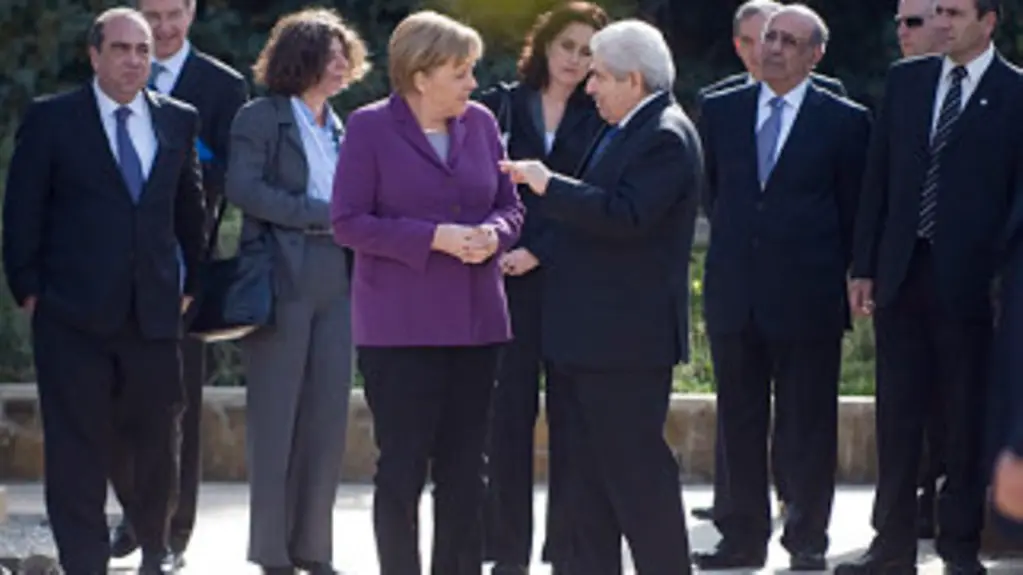
Chancellor Angela Merkel praises great willingness to compromise
Photo: REGIERUNGonline/Bergmann
The Chancellor expressly praised the efforts of President Dimitris Christofias to resume direct talks with the Turkish side. "We specifically appreciate your courage and your creativity," said Angela Merkel. It is regrettable that this willingness to compromise has "not hitherto been matched by the other side".
Both sides must be open to new moves
The Chancellor emphasised the fact that Germany supports the mediation efforts of the United Nations. In dialogue with Turkey, it will be made quite clear in future too that the process must make progress, said the Chancellor. Alongside Germany, all EU member states and NATO are equally interested in seeing a solution to the Cyprus problem.
It is not only its own experience as a country that was for many years divided that makes Germany encourage the essential process of reconciliation. It is also interested in fostering cooperation between NATO and the European Union in the field of European security and defence policy. This is currently possible only to a very limited extent. Irrespective of the outcome, it ought to be feasible to continue negotiations between the EU and Turkey on the possibility of Turkey acceding to the EU, she said.
Angela Merkel declared that she could "very well understand what the division of the country means" on an emotional level. Because the historical background is very different in Cyprus, the German reunification process cannot, however, be a model for Cyprus. Nevertheless, Germany is ready and willing to contribute its experience, for instance in resolving difficult issues of ownership, underscored the Chancellor.
Meeting with learners of German from North and South Cyprus
Alongside her political meetings, the Chancellor also met students from both the Greek and Turkish parts of the island. In the buffer zone that separates the two parts of Cyprus, they are learning German at the Goethe Centre. At the same time they learn to understand one another better. The cultural events and encounters are thus making an important contribution to fostering dialogue between cultures.
In 1960, immediately after the state was founded, Germany established diplomatic relations with the Republic of Cyprus, and is an important economic partner of the country. Since 1974 the island has been divided into the Greek Cypriot south, the Republic of Cyprus, and the Turkish Cypriot north. The Republic of Cyprus in the south of the island has been a member of the EU since 2004. The conflict between the two parts of the country is also an obstacle to cooperation between the EU and NATO.