
Berlin Process Summit in Montenegro
Federal Chancellor Merz attended the annual Berlin Process Summit in Montenegro, where he discussed the strengthening of economic and political relations there, together with representatives from EU and Western Balkan countries.
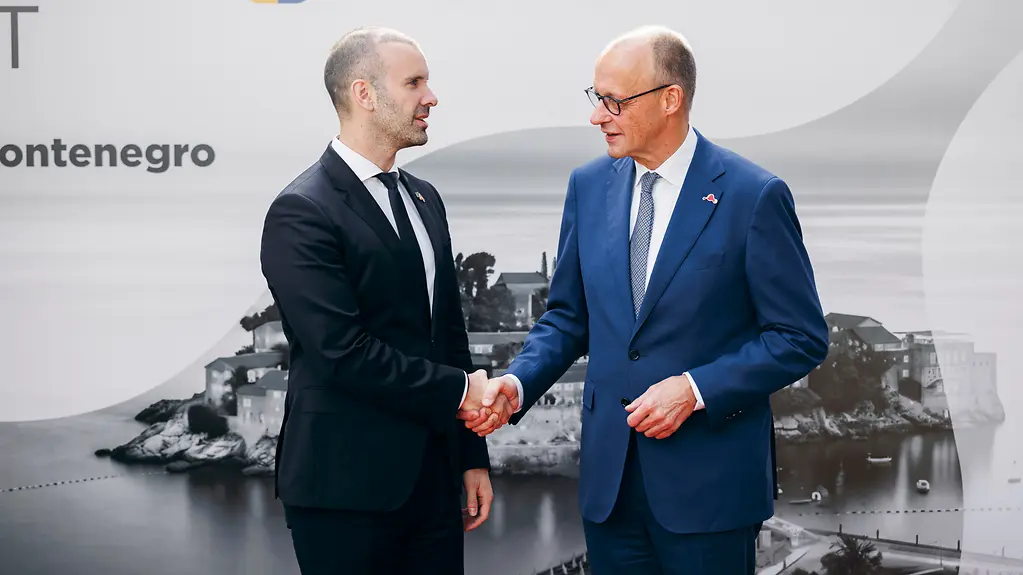
Federal Chancellor Friedrich Merz with his host, Prime Minister Milojko Spajić, at the summit in Montenegro.
Photo: Bundesregierung/Xander Heinl
“The countries of the Western Balkans belong to Europe, both geographically and politically”, emphasised Federal Chancellor Friedrich Merz at the joint press conference in Montenegro. Montenegro is well on the way to joining the EU soon. Other countries must, and will, follow. "We want to see this momentum behind EU expansion. The EU must grow if it is to assert its sovereignty in the world and be recognised as a clear force to be reckoned with", said Merz.
It is clear, however, that the political will must come "from the region itself". Whilst there is still a “difficult path ahead for the countries in the region”, Merz emphasised that it is important to note: “They are not alone on this journey. They are moving ahead together with their neighbours, and they are doing it with Germany and the other members of the European Union.
Austria assumes the chairmanship of the Berlin Process in 2027
At the start of the Berlin Process Summit, Federal Chancellor Friedrich Merz reiterated its objective: the European integration of the Western Balkan states. In doing so, the Chancellor also emphasised the need for the individual states to make further progress in the process of European integration. The Chancellor said in advance that this format would provide an opportunity to work together on the integration of the Western Balkans into the European community.
Federal Chancellor Merz also thanked the Prime Minister of Montenegro, Milojko Spajić, for his “wonderful hospitality in this very beautiful country”. For 2027, he handed over the chairmanship to Austria, which will assume the leadership of the forum next year.
At the thirteenth summit of the Berlin Process, the partner countries met in Montenegro for the first time. As the patron of the 2026 summit, the host country had extended an invitation for multilateral exchange to Sveti Stefan. In addition to the countries of the Western Balkans, other EU member states and institutions were also represented. Under the motto "Region in Motion – Owning the Change", the chair focused on cooperation in the fields of economic and security policy.
Germany stands alongside the Western Balkan states
By taking part in this year’s Berlin Process Summit, Federal Chancellor Friedrich Merz sent a clear signal of Germany’s support for the Western Balkan states. Germany plays a key role in these countries’ EU accession process. The Federal Government’s message is clear: As a key European partner, we will walk side by side with you on your journey towards EU membership.
The Western Balkans region in south-eastern Europe comprises the six countries of Albania, Bosnia and Herzegovina, Kosovo, Montenegro, North Macedonia and Serbia. These countries either have "candidate status" in the EU accession process or – like Kosovo – are potential candidates for accession.
The Western Balkans are part of the European family
“We must press ahead with the accession of the Western Balkan states”, said Federal Chancellor Friedrich Merz in July in Dublin, at the beginning of the Irish Presidency of the Council of the European Union. The EU must honour its promise of expansion and show successful candidate countries that it is serious about their accession.
This is not just in the interests of the Western Balkan states – rather, their integration is in Europe’s strategic interest. A gradual integration into European structures would strengthen stability, security and competitiveness across the entire continent. For the Federal Government, EU enlargement is therefore a top priority.
Capitalising on positive momentum
One of the Chancellor’s key priorities is speeding up lengthy procedures. In the accession process, he is advocating for a reformed approach that is less bureaucratic, yet transparent and merit-based. Together with French President Emmanuel Macron, Merz took the initiative to revitalise the accession process in June 2026.
The European Commission has also recently put forward proposals in its Pre-Accession Policy Review to speed up the accession of new members. From the Federal Government’s point of view, this positive momentum must now be harnessed to send a clear signal in favour of successful EU expansion.
The Berlin Process
The "Berlin Process" stems from a German initiative dating back to 2014. Since then, an annual summit has been held under a rotating chairmanship, accompanied by various ministerial meetings and side events throughout the year. The initiative aims to strengthen regional cooperation between the countries of the Western Balkans. Above all, the summit is also a forum for supporting these countries’ political and economic integration with the European Union.
In addition to Germany and the Western Balkan states, the forum’s members also include France, Italy, Poland, Austria, Greece, Croatia, Slovenia, Bulgaria and the United Kingdom. Representatives of the EU institutions are also regular participants.