
Speech by the Federal Chancellor during the general debate on the federal budget
Germany faces major challenges, emphasised Federal Chancellor Merz in his speech on the 2027 federal budget to the German Bundestag. Despite all the difficulties, the Budget Act takes into account “the concerns that many people in our country have”.
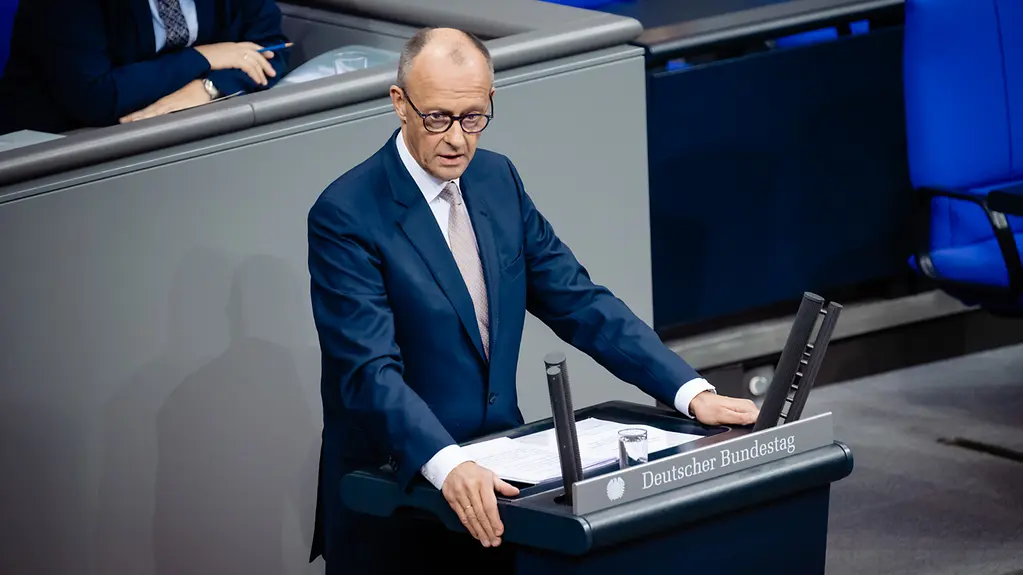
“Germany has for a long time cut back on the expenditures required for one of the state’s core responsibilities, namely ensuring external security,” said Federal Chancellor Merz.
Photo: Federal Government/Sandra Steins
“As a country, we find ourselves in a difficult situation geopolitically, technologically and demographically,” said the Federal Chancellor at the start of his speech on the federal budget in the German Bundestag. Nevertheless, they have managed to draw up a budget that takes into account the concerns “that many people in our country have”. However, the Chancellor also pointed out that there will be less financial leeway in the coming years. He therefore believes it is essential to draw up future budgets in such a way that “future generations also have the financial means and freedom to shape their own futures”.
The Federal Chancellor singled out four areas in particular – defence, infrastructure, demographic change and the economy – in which “fundamental issues have been neglected for far too long”. Revenue and approved borrowing would not suffice to make up for unaddressed matters. Consequently, special loans had to be taken out.
The Federal Chancellor spoke about issues, including…
... security and defence
“Germany has for a long time cut back on the expenditures required for one of the state’s core responsibilities, namely ensuring external security,” said Merz. In the face of concrete threats, this Federal Government has ensured that Germany is now better equipped to defend itself than it has been at any time in recent decades.
By supporting Ukraine – the Federal Chancellor firmly believes – “we are also supporting and protecting ourselves”. After all, our freedom is at stake too. Europe must make its limits clear to Russia. There is a shared determination to do so, as last week’s meeting of the ‘Coalition of the Willing’ demonstrated once again.
… Infrastructure and carbon neutrality
Funds are now available through the Special Fund for Infrastructure and Climate Neutrality. “And we have put in place the legislative framework to ensure that investment and construction can take place swiftly,” said the Federal Chancellor. As an example, he cited the Construction Turbo and the Infrastructure Future Act.
… demographic change
For far too long, people have refused to draw the necessary conclusions from demographic trends. Here, too, the Federal Government has changed course. The goal: A reform of the social security systems, “in such a way that they remain reliable and affordable at the same time”.
On the subject of pensions, Federal Chancellor Merz pointed out that, by offering incentives to work longer into old age, adjusting the rules on early retirement without a reduction in benefits, and making use of the capital market, pension levels could rise and contributions could fall in the medium term.
… the economy
Entrepreneurial activity has become too expensive, and opportunities for innovation have been left untapped. This Federal Government is changing that by cutting taxes, reducing energy costs, cutting red tape and reducing labour costs through the stabilisation of social security systems.
Furthermore, the Federal Government is promoting structural change in the economy through a shrewd technology policy. There is a great deal happening in the field of new technologies, on the path towards industrial AI, in defence and medical technology, in space, in climate-neutral production and mobility, in many fields of research and innovation, and also in the implementation of business ideas and start-ups. All of this is evident and “is, for me, one of the many reasons for optimism in the coming months”, said Merz.
Problems that have built up over decades “cannot be solved with just one or two budgets,” said Merz. “But we have started to change course.” He pointed to the positive trend in economic forecasts and export figures, the rise in the number of start-ups, and the innovative strength of our economy.