
Foreign policy
Angela Merkel has flown to Beijing to begin a week-long visit to China and Japan. The Chancellor will wear two hats during the visit. In her capacity as German Chancellor, she will focus on bilateral relations. As G8 President, she represents the interests of many other countries. Climate change issues are to feature prominently regardless of which hat the Chancellor wears.
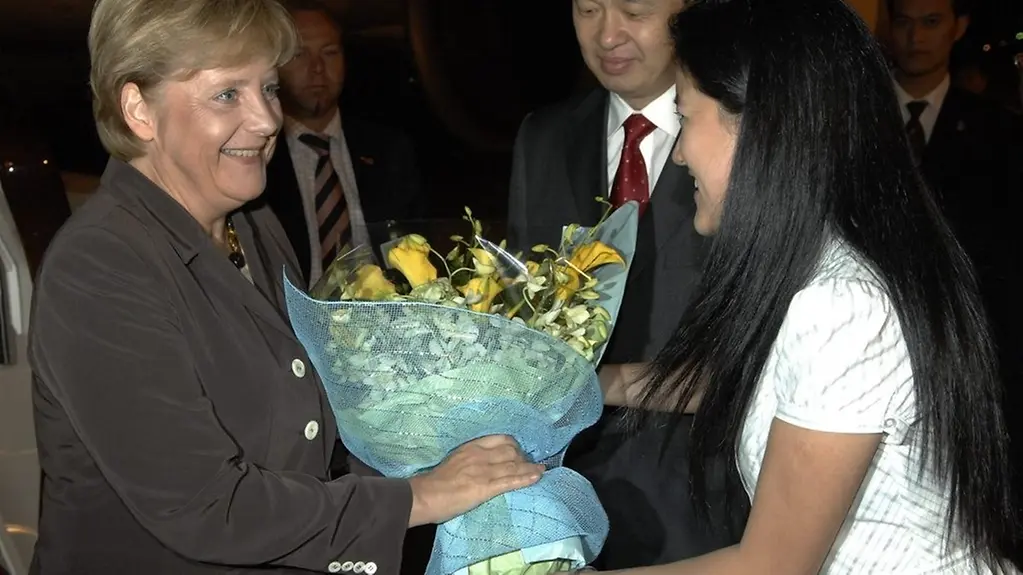
Merkel arrives in Beijing
Photo: REGIERUNGonline / Kugler
Chancellor Merkel intends to take a lot of time for her talks with Prime Minister Wen Jiabao and President Hu Jintao in Beijing. Apart from climate change and energy policy, other key issues on the agenda include economic relations, protecting intellectual property and human rights.

Stages along the way
Photo: Globus
Climate and Energy: Heiligendamm process to be stepped up
China has become the second-biggest CO2 emitter nation in the world. Yet at the recent G8 summit, Chinese delegates took a somewhat reticent stance to climate change, saying it was mainly a matter for the large industrialised nations who were responsible for the global rise in CO2 emissions.
There has since been some movement in the climate debate in Beijing. The Chinese government is taking the matter more seriously. This is a good sign as the Chancellor goes into talks with her Chinese hosts.
China, India, Brazil, Mexico and South Africa, five of the biggest emerging economies or ‘outreach’ nations, attended the meeting of the world’s eight most powerful industrialised nations in Heiligendamm this June.
It was at that meeting that Chancellor Merkel initiated the Heiligendamm process with the aim of involving important emerging economies in global policy issues. They are all called upon to play their part in reducing CO2 emissions and in efforts to combat global warming.
China: Asia-Pacific’s economic giant
In any German state visit to China, talks focus on economic relations. This visit is no exception, with Chancellor Merkel being accompanied by a 25-strong industry delegation. Germany’s Mittelstand (small and medium-sized enterprise) is as well represented as its multinationals. Among the delegates are representatives from Thyssen Krupp, heavy vehicle manufacturers MAN and the German airline Windrose Air.
The aim of the visit is to boost German exports and investment. Germany has a 21 billion euro trade deficit with China. Only three percent of German exports and one percent of Germany’s foreign investment went to China in 2006. But given the huge potential in these sectors, the outlook is good.
One of Chancellor Merkel’s key aims is to get the Chinese government on board in the fight against piracy and theft of intellectual property.
China is Germany’s biggest trading partner in the Far East. According to figures from the Federal Statistical Office (destatis), imports from China were up in 2006 and were worth almost 49 billion euros. This puts China in third place in the exports to Germany rankings. Clothing has long ceased to dominate, and top imports now include computer equipment and office technology. China has already overtaken the US as an export power and is hard on Germany’s heels in the world’s greatest exporter stakes.
No issue left unaddressed: Human rights in China
Just a year before the 2008 Olympic games, Chancellor Merkel is particularly concerned about the freedom of the press. Her agenda regarding this issue thus includes talks with the Chinese government, online journalists, authors and representatives from independent media.
The Chancellor will visit Nanjing in eastern China to discuss progress in the debate on application of the rule of law.
Handing over the baton in Japan
Climate change will also top the agenda in Japan. Chancellor Merkel is to hold a keynote speech in Kyoto – a fitting location in that her visit to the Far East also focuses on preparations for the UN Climate Change Conference in Bali next December.
Bali will host negotiations on how to proceed post-Kyoto. Sights have been set high: the target is to halve CO2 emissions by 2050.
Japan takes over the G8 presidency in 2008 and will also make climate change a key point of focus.
Chancellor Merkel is visiting Japan for the first time. While she has already met Prime Minister Abe, the Chancellor will have her first audience with Emperor Akihito on Thursday.